Showing posts with label history. Show all posts

Friday, May 17, 2013

Eyecatching

If you've been searching for a way to attract curious, suspicious, and sometimes hostile stares at bus stops and in waiting rooms, I've got a hot tip for you. Just borrow my copy of "Heil Hitler, das Schwein ist tot!" ("Heil Hitler, the Pig is Dead!") People will only recognize the first two words and won't know what to make of them (and, by extension, you). Good times will be had by all!


I just finished reading it and if it weren't in German, I would say READ IT! READ IT NOW! Since it's in German, though, I'll say LEARN GERMAN! LEARN GERMAN NOW! THEN READ IT! READ IT THEN!

The book chronicles the evolution of jokes about the Nazis (and also of the punishments for telling these jokes) from the earliest years of the party up to the 1990s. Herzog gives lots of examples and makes some good points about the nature of many "anti-Nazi" jokes told during the Third Reich - namely, that they weren't actually political in nature; they focused on the personal foibles of the Nazi leadership (Goebbels walked with a limp, Göring loved his military service medals, etc.) and weren't seen as any real threat to the regime.

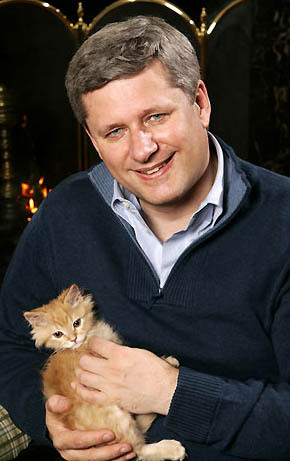
To draw a parallel, when I make a joke about how Stephen Harper had to have his picture taken with a kitten to prove he's not a robot, this is in no way dangerous to Stephen Harper's government because it's not aimed at his policies. In fact, if I basically support Stephen Harper,* this joke might even make me like him better - after all, we tease the people we love.

I'm going to leave you with a translation of the titular joke, which was told in the closing days of the war, as Germans began to realize that they were going to lose the war and some jokes became more openly hostile to the Nazi leadership.

Hitler and his chauffeur are driving through the countryside when, all of a sudden, they feel a bump and realize they've run over a chicken. Hitler says to his chauffeur, "We've got to tell the farmer. I'll do it - I'm the Führer, he will understand." Two minutes later Hitler comes running back to the car, rubbing his jaw - the farmer punched him. They drive on. A few miles down the road, they feel another bump - they've run over a pig. Hitler says to his chauffeur, "This time, you get to tell the farmer." The chauffeur obeys this order and comes back to the car an hour later, drunk on good wine and carrying a basket full of sausages and cheese. Hitler is amazed and says, "What did you tell them?" The chauffeur responds, "All I said was 'Heil Hitler! The pig is dead!' and they gave me all these presents!"

* I don't, just so we're clear.

Monday, August 13, 2012

Good night (and goodbye) Berlin


I like the Brandenburg Gate (like most landmarks) better after dark. Things lit up at night always make me feel like Christmas and it's easier to get pictures without people popping up in front of your camera like crasher squirrel.


This is, hands down, my favourite memorial in Berlin. It's on (or under, I guess) Bebelplatz, where in 1933 the Nazis burned over 20,000 books deemed "un-German". You look through this window into a room lined with empty bookshelves and, nearby, there's a plaque with the Heinrich Heine quote "Where they burn books, they will end by burning people". I must have taken pictures of this group for at least five minutes and there are several pictures where one of the group members is giving me the evil eye. But I was there first and anyway, I think the picture's better with people in it!


This is 1/3 of the Gendarmenmarkt, the "prettiest square in Berlin". The square is framed by an opera house and two former cathedrals (now museums) - the French Cathedral and the German Cathedral. The French Cathedral was built first and the German one (above) was built to "match". It was supposed to be the twin (in size and almost in design) of the French building, but then they made it one metre taller. The anti-French shenanigans never stop in Berlin!


And this is the Berlin Cathedral again, with the apparently indefatigable Fernsehturm still playing peekaboo. It's 11 pm, Fernsehturm! Go to bed!

Straight spyin'

While I'm not going to suggest that the Stasi* in East Germany was anything other than terrifying (because imagine not knowing if your neighbours, coworkers, or family members were spying on you and reporting back to an agency that could straight-up ruin your life), this formerly-classified document showing the many disguises of a Stasi agent is unintentionally hilarious.


Fun fact: Stasi files are now open to the public (within limits). If you lived in East Germany, you can go look up your file and find out what the Stasi knew about you. This represents the first time in history citizens have managed to force a secret police service to open their files, which is pretty cool when you think about it.

*short for Ministerium für Staatssicherheit (Ministry for State Security)

Berlin 101

The Brandenburg gate was finished in 1791 and topped with the figure of Victory in her chariot. But when Napoleon conquered Berlin in the 19th century, Victory (and her chariot) were shipped off to Paris. Of course, the Prussians got the statue (and Berlin) back eventually and put her back on top of the gate. And then, just to show the French who's boss, they renamed the square in front of the Brandenburg Gate "Paris Place", so that they would always have Victory over Paris. And people say Germans don't have a sense of humour!


This is the Reichstag building, which houses the German parliament (Bundestag). The Reichstag fire in 1933 served as Hitler's excuse for assuming emergency powers (which he kept until his suicide in 1945). It's been refurbished with a new glass dome where you can look down and see parliament in session. A symbol of transparency and so on...


But lest you think there's nothing you'd like better than frying up a few Bratwürste while watching the sun set over the Reichstag:


It's VERBOTEN. I wonder what the Alberta Legislature's stance on grilling is?


This is the Fernsehturm (TV tower), which was built to make the West Berliners insanely jealous of East Berlin's technological prowess. The first time I was in Berlin, I decided against taking the elevator up the tower and I've been regretting it ever since. So this time I manned up, paid the twelve Euros and waited the two hours. And then I stayed up there until I felt like I'd got my money's worth (three hours).


This is the Memorial to the Murdered Jews of Europe. The name's a little unwieldy, but the monument's quite impressive. It's a little hard to tell from the picture, but the ground rises and falls between the blocks, which are all the same size but different heights. You can walk between the blocks, but the aisles are narrow and you have to walk single file. It's quite cold in there, even when it's hot outside, and it's really easy to lose your companions because the monument covers an entire city block and the chances that your paths will converge is minimal. The general consensus seems to be that it's supposed to give you some idea of how the Jews felt (isolated and terrified) and that its sheer size is supposed to make it hard to ignore. 


This is the Berlin Cathedral (with the Fernsehturm playing peekaboo). The cathedral is old by Canadian standards (completed in 1905), but it has no business looking quite as old as it does - it was deliberately "aged" to fit in with the older buildings around it.

Friday, August 10, 2012

Solidarnosc

In 1980, while Poland was still under communist rule, Danzig's shipyard workers went on strike. The Solidarity trade union was formed and the concessions they won were the beginning of the end for communism in Europe. This is the shipyard gate in 1980, when thousands of people waited outside for news of the strikes.


And this is the shipyard gate in 2012. On the right you can see the two boards where the shipyard workers wrote their list of demands. Most of them were the sorts of things that every worker everywhere should be entitled to (and they were, in large part, granted), but the one that made me laugh was three years of paid maternity leave. "And we're still waiting."


Of course, it wasn't an easy path from the strikes of 1980 to the fall of communism in Europe. The communist regime struck back with a wave of pretty vicious oppression in 1981 and things definitely got worse before they got better. Members of the resistance started wearing electrical resistors as a sign of their opposition to the regime. Cool, yes?


An aside: While I was in Danzig, the hero of the shipyard strikes and former president of Poland, Lech Walesa, publicly endorsed Mitt Romney. You were doing so well, dude! What happened?

Westerplatte - where World War II began

By the terms of the Treaty of Versailles in 1919, Danzig (formerly a part of the German Empire) became the Free City of Danzig ("a semi-autonomous city-state" - Wikipedia). Poland had the right to use parts of the port and to represent the Free City in dealings with the outside world, but the UN didn't want to just go ahead and give it to Poland because the population was 95% German. Sound complicated? It was. And also, nobody was happy. Germany really wanted Danzig back and the Poles complained that everyone in Danzig was mean to them even though the UN said they were allowed to be there.

Fast-forward to 1939: the German battleship Schleswig-Holstein anchors at the Polish harbour of Westerplatte (just a few kilometres north of Danzig) on a "courtesy visit", but by this time the Poles know that it's only a matter of time until the Germans attack, so they've secretly been fortifying Westerplatte with guardhouses and extra troops. Sure enough, on the 1st of September, German troops fire on Westerplatte and World War II begins. Long history short, the "Defenders of Westerplatte", who were supposed to be able to hold out for 12 hours (long enough for reinforcements to arrive), held out for seven days before they surrendered.


That's why they got this very sixties monument from the communists, who tried to leverage this story of Polish heroism into support for their regime.


On my second day in Danzig, I took a boat up the river to Westerplatte and wandered through the forest for a couple of hours. There's not a lot left, but there's quite a good outdoor exhibit and you can walk through the barracks, which gives you an idea of the damage that Westerplatte sustained.


A last note: the German commander who accepted the eventual surrender was so impressed by the Polish defense that he allowed the Polish commander to keep his ceremonial sabre in captivity, which is apparently a sign of soldierly respect. It's also the kind of story that makes me cry.

Wednesday, July 25, 2012

Auschwitz/Birkenau

You should know that I've wanted to visit Auschwitz for a long time. I've been to a few concentration camps in Germany and probably won't go to any more, but Auschwitz has a special distinction, for lack of a better word, as the worst of the worst and that's why I thought it would be worth visiting.

So first let me say, Auschwitz: totally worth visiting.

Normally I'm not a huge fan of guided tours around museums because they don't give you enough time to read every single word on every single sign in every single room. But I have to say that the guided tour at Auschwitz was a good decision (I say "decision", but actually they won't let you visit alone between 10 am and 3 pm). The guide was incredibly well-informed and struck exactly the right tone. He didn't fall into the trap of spending four hours over-using adjectives to describe how terrible the camps were; he just showed us around and explained what we were seeing. Auschwitz kind of speaks for itself. So 5 stars for the guide, really.


Auschwitz in 2012 looks a lot like a college campus during Orientation Week, with rows of tidy brick buildings and lots of people wandering around looking confused and a little scared. Of course, during the Second World War the lawns were mud and filth and there were people dying or being killed all around. I didn't take any pictures of the rooms full of hair, shoes, brushes, suitcases, spectacles, or children's toys which were just a small fraction of the things stolen from the prisoners either before or after they were killed. You can find pictures on Google if you're interested, but I think they lose something in a photograph.


What struck me the most was the awful hypocrisy of the camps. There was a document on display (below) in which the SS ordered a truck to pick up "materials for the Jewish resettlement" from a nearby town. By "materials for the Jewish resettlement", they meant canisters of Zyklon B, which they would use in the gas chambers. And they knew this when they wrote the document. And the way they disguised the gas chambers as showers... they didn't just tell the people they were about to murder that they were showers, they went to the trouble of installing fake showerheads and a dressing room with hooks, where the prisoners were told to hang their clothes and remember where they left them so they could find them later. And again, the people who relayed these orders were 100% aware that they were about to kill these people. Like, if you're so proud of what you're doing, own up to it! If it's not a terrible, terrible thing to do, why do you have to hide it?


Later in the tour we took the bus to Birkenau, the camp the SS built when they realized they weren't killing people efficiently enough at Auschwitz. At Birkenau, the train could pull right into the camp to offload prisoners and half of the barracks were wood, rather than brick, which offered even less protection to the prisoners during cold Polish winters. A great achievement, I'm sure.


Birkenau was not as well-preserved as Auschwitz - after liberating both camps, the Russian Army dismantled a lot of the barracks at Birkenau; the war was still on and they needed the wood - and I therefore found it harder to picture what had happened there. Also, at this point we were four hours into the tour and I needed a sandwich.

Fact: the two warehouses at Auschwitz (where the Nazis kept the things they took from the prisoners before either killing them or putting them to work, which would kill them within days, weeks, or months) were named after Canada (Canada I and Canada II), because Canada was seen as a land of great wealth and promise and the warehouses were where they kept the "great wealth" they plundered from the people they then murdered. And that's a strong candidate for "worst compliment Canada has ever received".

So: quite depressing, very informative, completely worthwhile. That's my review.

P.S. There were signs up all over Auschwitz with a list of "do's and don'ts", most of which were pretty self-explanatory. The one that made me laugh was "No children under 12 without parents or guardians." Because, pro tip: If you sent your ten-year-old to Auschwitz alone, you're not going to be winning any "best parent" awards.

Wednesday, July 11, 2012

What's in a name?


This is the Schöner Brunnen (Beautiful Fountain) one of the most famous sights in Nuremberg's Hauptmarkt (market square). It really is beautiful, albeit in a very, very ornate sort of way - apparently they weren't super into minimalism in the 14th century. It was encased in concrete during the Second World War, which is why it's still standing today even though 85% of Nuremberg's old town was leveled by Allied bombing raids.


There's a local legend that turning the brass ring set into the decorative iron fence will bring good luck, but this is clearly a trap because there are actually two rings. There's always a crowd of tourists standing in front of/having their picture taken with each ring and no one's ever been able to tell me for sure which one's the "right" one. And since the "wrong" one is said to make you pregnant, I figure it's better to just stay away from the rings altogether.


In the winter, it's a centrepiece of the world-renowned (WORLD-RENOWNED, LADIES AND GENTLEMEN) Nuremberg Christmas Market and looks particularly pretty all lit up.

Wednesday, June 27, 2012

Schwarzfahrer

Germany is not exactly ethnically diverse; according to Wikipedia, 91.5% of Germans are ethnically German. The next biggest ethnic group, Turks, accounts for just 2.1% of the population. Of course, just because a country is not ethnically diverse does not automatically mean it has a racial problem, any more than an ethnically diverse country is automatically a haven of peace and multicultural understanding. But, well...

Germans are especially sensitive to accusations of racism, partly, I think, because the unspoken follow-up to such an accusation is "and remember what happened the last time you were racists?" There's a strange, wishful perception that World War II took care of racism in Germany once and for all. It's a huge blind spot and I've often been surprised at the uncensored comments from people who would in no way consider themselves racist but who say (and apparently think) some astonishingly racist things.

So that's an introduction to this Oscar-winning (oooooo, ahhhhh) German short film called Schwarzfahrer. The literal translation of Schwarzfahrer is "black rider" and it's the term used for someone using public transportation without a ticket. In the film, it's also a visual pun! But watch it and then I won't have to explain it.


If that didn't make you want to slap that old woman, I don't know what would. Make you want to slap an old woman, that is. Anyway, she got her comeuppance and I got an excuse to use the word 'comeuppance'. Everybody wins!

Tuesday, June 19, 2012

It's a Harz knock life

A few weekends ago, we headed up to the Harz National Park for a long weekend of climbing. It's something of an annual trip for my friends here, but it was the first time I'd been. We slept in the garden at Christian's parents' house, ate their food, drank their schnapps, and got hand-knitted socks from his mom. So yeah, it was great.

The Harz National Park is in north-central Germany, approximately (very approximately) where the yellow star is and just east of the former East/West German border. Christian's parents missed ending up in East Germany by about 10 km.


The climbing in the Harz is on granite, which I think is my new favourite kind of climbing. It's a little hard on the knees, elbows, ankles, and fingertips, but skin grows back and just look how pretty it is!


And I finally got to do some multi-pitch! Now in my mind, multi-pitch is hanging from a belay you built yourself, 300 metres up with nothing but air beneath you. But, thank goodness, that's not what all multi-pitch is like, otherwise you might not be reading this because I might not have written it because I might have died.


We did one last route as the sun set on Monday evening and then drove back to Nuremberg in the dark.


And now, history: During WWII, the Harz region was quite important for munitions manufacturing and a lot of the labour was supplied by forced-labour camps. V-2 rockets were built underground by prisoners working in horrifying conditions. At the end of the war, 40,000 of these prisoners were marched through the Harz as the German line retreated from the Allied advance. 10,000 died of exhaustion or were shot because they couldn't keep up. Just your daily reminder that something horrible has happened in every beautiful place.

And lest you think that's a depressing way to end a post, I'm sure something beautiful has happened in most horrible places too.

Wednesday, June 6, 2012

Pop psychology

Hey! This song is called "Schrei Nach Liebe" ("Cry for Love") and it's by Die Ärzte (the Doctors), a venerable punk rock band from Berlin. It's an anti-fascist anthem that makes the highly-nuanced argument that fascists are fascists because their mothers and/or girlfriends didn't love them enough. Clearly the Doctors are psychologists, amirite?

But seriously, it's pretty catchy and it's great for singing to yourself when you're trying to convince yourself to do something you don't want to do.


Speaking of fascists (smooth segue), check out this video.


It's worth noting that while 25,000 fascists sounds like a lot (and it's obviously 25,000 fascists too many), that's only about 0.03% of the German population. It's not like Germany is crawling with neo-nazis. Also, how clever are those t-shirts?

Monday, April 23, 2012

Oh man

If you liked my last movie recommendation, you're going to love this one. Just kidding, they're totally different. But they're both great!


This one is called Max Manus: Man of War and the tagline is "They stole his country. Now he wants it back." Yes, that's a very douchey title. Yes, the tagline is even douchier. But - BUT - the movie is awesome. It's ironic, because I think the people who would enjoy this movie would be totally alienated by the way it's advertised, and the people who are drawn in by the title/tagline would hate it.

The movie is about the Norwegian resistance during the Second World War, and I'm going to go out on a limb and say that the Norwegian resistance was one of the most bad-ass resistance movements. But it's not just about blowing stuff up and running from the Nazis (although it is definitely about those things) - it's also about the emotional impact of dedicating yourself to a cause that ends up killing most of your friends and making you question what you're even fighting for. Deep, right?

Oh, and you will have to watch it with subtitles (unless you speak Norwegian), but it's very much worth it.

Friday, April 13, 2012

Listen up

What do you call a movie that combines HISTORY and SATIRE and NAZIS and SPACE? You call it Iron Sky and you should go see it.


Also, I'd like to draw your attention to "The battle for Earth is gonna get Nazi." Great tagline or greatest tagline?

Friday, March 16, 2012

Memorials 101

You'll see these all over Germany if you're looking for them - these ones are in a small town called Dinkelsbühl, but I've seen them in many other cities and towns as well.


They're set into the pavement in front of houses and apartment buildings, and each one gives the name and date of birth of a Jewish person who once lived at that address, along with their fate (in this case, an entire family - including a 7-year-old, an 8-year-old, and a 9-year-old - was deported and killed in concentration camps).

It's going to sound weird when I say that I love these memorials, but what I mean is that I think they are so much better than a big, ostentatious statue in the middle of town. Most people (especially in Germany) have a pretty good idea of what happened during WWII, but it's pretty remote from our daily lives. These memorials are something subtle that remind us that bad things don't just happen far away.

Tuesday, March 13, 2012

Thursday, March 8, 2012

Lolcar

Bet you thought I just misspelled lolcat, eh? WRONG.


The licence plate game is more fun in Germany, because every city and halfway-decent-sized town has its own letter(s) and then they just throw some more letters in there for fun. Nuremberg's letter is, creatively, 'N'. Fürth, a few kilometres from Nuremberg, has FÜ and I'm just waiting for the day when I see FÜ CK 293. Apparently they're out there, so if I don't stumble across one soon I might have to get on my bike and track one down.

Fun fact: Although FÜ CK is apparently just fine, there are banned licence plate combinations, most of which have to do with the Nazis (shocker). NS (national socialism) is banned, as are SS, SA, HJ (Hitler Youth), KZ (concentration camp), HE IL, and IZ AN (Nazi backwards).

P.S. Please do stay tuned for German lolcats.

Tuesday, March 6, 2012

So this is where I'm at

In case you've forgotten (or never knew) where exactly I've been for the last three years: GERMANY! Specifically, a grrrreat city in Franconia/Bavaria (more on that later) called Nuremberg. Back in the day, Nuremberg was famous as the home of the Nazi Party Rallies. The Nuremberg Laws were enacted about 300 m from my apartment (not cool, guys) and after the war, war criminals were tried in the Nuremberg Trials. These days, Nuremberg is famous for lebkuchen (kind of like gingerbread) and drei im Weckla (three sausages in a bun). How times change.