Showing posts with label German culture. Show all posts

Tuesday, September 29, 2020

This is where I'm at, again

I started this blog in 2012 when I had an inkling that my time in Germany was drawing to a close—partly as a record of all the things I found either delightful or maddening (or both!) and partly, maybe, to process how I felt about leaving after three years of pretty high highs and relatively low lows.

Now, eight years later, I'm at the point where, barring any change in circumstances, my departure from Germany is once again reasonably foreseeable. And, once again, I suddenly feel like I have a lot to say about this place where I've now spent almost half of my adult life.

But enough of the feelings and on to the lolz, amirite?

Germans have a reputation as a very literal people. Although they've produced famed poets (Brecht! Goethe! So I've heard, at least!) who could wield metaphors and other figurative language with the best of them, on the whole I have found this to be true. Don't pose a rhetorical question to a German unless you want it answered. Sometimes this is infuriating! And other times, well...

I was at the library, in the Before Time, when I came across the German DVD of Life of Pi. In English, it's an enigmatic title. It plays its cards close to the vest. It's also a title that is extraordinarily easy to translate into German. Leben von Pi. Boom. That'll be five bucks because I'm a professional translator now. But instead, they went with...


... Schiffbruch mit Tiger. That's Shipwreck with Tiger, for all you non-German-speakers out there. And just like that, the mystery is gone. The bubble has burst. Thanks, Germany.

Friday, June 7, 2013

YOLNT (or ST)

When you move to a new country, there are cultural differences that affect your whole life. They can make you think twice before speaking, wonder if you'll ever make friends, and eventually have only-half-joking fights with those friends about which culture got it "right."

And then there are the the little differences, the weird ones, the curiosities. I like those the best. Things like this: You know how cats have nine lives? FALSCH! In Germany they only have seven.


What??? That's probably half the reason this German cat looks so sad.

Part of what interests me so much about these little differences is wondering where they came from. I mean, how did it happen that we all agree that cats have multiple lives (weird enough on its own) but somehow settled on different numbers? Is there an epic story behind this - a tale of conflicting interpretations where we finally, maturely, agreed to disagree (although not before a great deal of blood had been shed and a number of impassioned speeches made)? Or was there just a translation mistake somewhere down the line that took root in the public consciousness and affected the entire course of the future (cat-related myths being an important subset of the future)? We may never know...

Friday, May 17, 2013

Eyecatching

If you've been searching for a way to attract curious, suspicious, and sometimes hostile stares at bus stops and in waiting rooms, I've got a hot tip for you. Just borrow my copy of "Heil Hitler, das Schwein ist tot!" ("Heil Hitler, the Pig is Dead!") People will only recognize the first two words and won't know what to make of them (and, by extension, you). Good times will be had by all!


I just finished reading it and if it weren't in German, I would say READ IT! READ IT NOW! Since it's in German, though, I'll say LEARN GERMAN! LEARN GERMAN NOW! THEN READ IT! READ IT THEN!

The book chronicles the evolution of jokes about the Nazis (and also of the punishments for telling these jokes) from the earliest years of the party up to the 1990s. Herzog gives lots of examples and makes some good points about the nature of many "anti-Nazi" jokes told during the Third Reich - namely, that they weren't actually political in nature; they focused on the personal foibles of the Nazi leadership (Goebbels walked with a limp, Göring loved his military service medals, etc.) and weren't seen as any real threat to the regime.

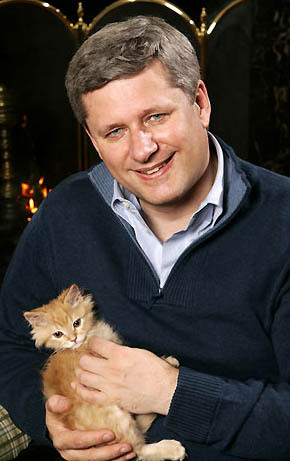
To draw a parallel, when I make a joke about how Stephen Harper had to have his picture taken with a kitten to prove he's not a robot, this is in no way dangerous to Stephen Harper's government because it's not aimed at his policies. In fact, if I basically support Stephen Harper,* this joke might even make me like him better - after all, we tease the people we love.

I'm going to leave you with a translation of the titular joke, which was told in the closing days of the war, as Germans began to realize that they were going to lose the war and some jokes became more openly hostile to the Nazi leadership.

Hitler and his chauffeur are driving through the countryside when, all of a sudden, they feel a bump and realize they've run over a chicken. Hitler says to his chauffeur, "We've got to tell the farmer. I'll do it - I'm the Führer, he will understand." Two minutes later Hitler comes running back to the car, rubbing his jaw - the farmer punched him. They drive on. A few miles down the road, they feel another bump - they've run over a pig. Hitler says to his chauffeur, "This time, you get to tell the farmer." The chauffeur obeys this order and comes back to the car an hour later, drunk on good wine and carrying a basket full of sausages and cheese. Hitler is amazed and says, "What did you tell them?" The chauffeur responds, "All I said was 'Heil Hitler! The pig is dead!' and they gave me all these presents!"

* I don't, just so we're clear.

Thursday, July 19, 2012

The night bus

In my quest to discover Eastern Europe while staying in countries covered by my health care insurance, I set off to Poland Monday night. I always seem to book night buses (or trains! or planes!) when they're available, reasoning that I'll save money on accommodation and I'll probably be able to sleep just fine. RIGHT. Anyway, this particular night bus was full of Polish grandmas, their hand-embroidered throw pillows, and their sandwiches wrapped in aluminum foil. Cute!

The entertainment for the evening was an English movie "dubbed" into Polish. I say "dubbed" because all the voices were done by one person, a man, who apparently felt no need to match his voice to the lips onscreen or to sound angry when the characters were clearly angry.  It's surprisingly disconcerting to hear the same voice coming from the mouths of Adam Sandler, Salma Hayek, Chris Rock, and the guy who played Deuce Bigalow (male gigolo). Oh and they didn't bother to edit out the English voices, so the whole experience was most reminiscent of a foreign documentary or simultaneous translation at the UN. Compare this to Germany, where even the crappiest of movies are dubbed with the care and accuracy befitting a cinematic masterpiece and where the voice actors for the big Hollywood stars become rich and famous in their own right.*  But the lady next to me was loving it; she lol-ed all the way to the Polish border.

Anyway, 12 hours, three sandwiches, and one epic neck cramp later, I'm in Poland! It seems nice!

*This seems like an appropriate moment to mention that a former roommate of mine is now living with the German voice actor for George Clooney. Clearly she's moving up in the world.

Tuesday, July 17, 2012

Luftwaffe

Now that football is over until 2014, it's time to turn our attention to another German national obsession: lüften. This translates to "airing out" and is one of the first words I learned in Germany because they use it, well, constantly. In Germany, there is nothing that can't be lüften-ed: bedrooms, bathrooms, classrooms, cars, clothes, kitchens, sheets, pillows, rugs, tents, shoes, sleeping bags... if you can name it, Germans can lüften it. It is absolutely essential to lüften regularly in order to get rid of schlechte Luft (bad air, which most Germans visualize as a malevolent presence hovering over them at all times) and replace it with frische Luft (fresh air).

These are the same Germans, by the way, who are convinced that if you go outside with wet hair you will 100% no doubt about it get a cold or a bladder infection or maybe even a heart attack. Clearly, Germans have a deeply ambivalent relationship with Luft.

Monday, July 2, 2012

Going over to the dark side

There's an inexplicable belief in Germany that herbal tea is somehow "real tea", as opposed to the coloured hot water it really is. In fact, herbal tea is the default in Germany. If you want real tea, you have to specifically ask for "black tea" or "green tea" or else you're getting some sort of Hagebütte-Holunderblüten-Sonnenblumenblütenblätter-Schwachsinn (rosehip-elderflower-sunflower-petal-nonsense).

Anyway, the Empire (and not the British one) has won. I woke up this morning to a grey, depressing sky and my first thought was, "Ooo what about brewing a nice herbal tea and answering a few emails?" This simply will not do.